Aging Wine

March 21st, 2013

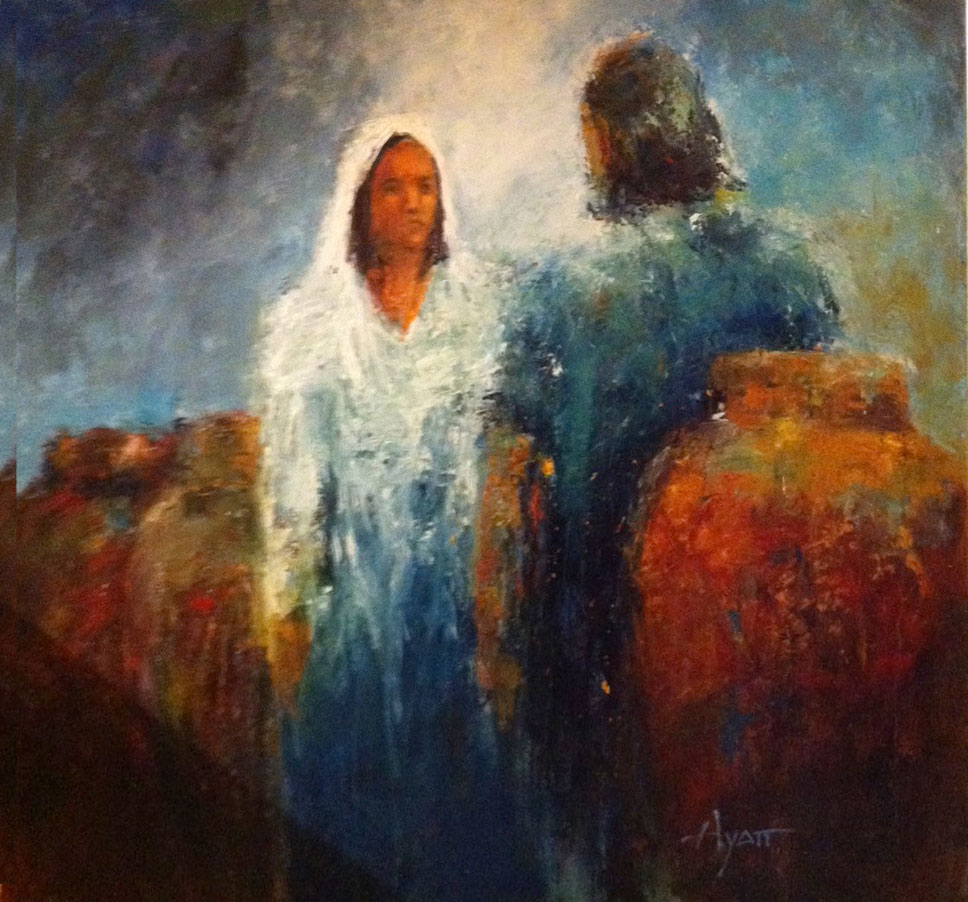
Water to Wine, oil on canvas, 48×48

I find it amazing, verging on amusing, that the first miracle Jesus performed was at a wedding banquet experiencing a catering crisis.* With all the problems in the world . . . world hunger, world peace, world anything . . . he was approached by his mother who merely said, “They’re out of wine.”

You know the story. He sent her away without a word, instructed the servants to fill all the huge hand-washing jugs with water and then take the emcee a sample. The emcee took one taste and exclaimed, “Wow, they’ve saved the best till last!”

We might be surprised that Jesus was in the wine making business at all. But we can be confident of one thing: if he’s going to make wine, it’s going to be the best that was ever made, before or since.

I’m reminded of the old fraternity joke that goes, “I don’t care what his religion, if he can turn water to wine, pledge him!”

Of course, he only did it once; he really did have world peace to deal with . . . one person at a time. In another way of thinking about it, however, he’s been doing the miracle ever since.

Here are some lines from my sketch book, personalizing it all.

Lord, You have done your
Wine-making miracle
over and over . . .
and done it again in me.
Taking the plain water of my life
and turning it into wine.
AND
Inasmuch as the wine you create is always best,
and with me now somewhat aged
(flavored with anise and plum and a balance of tannins and acids with a hint of vanilla and dark chocolate)
Wouldn’t it be best to pull out the cork,
pour it around
and let it be savored and drunk
by all who have a taste
and a thirst
for such?


I’ll drink to that. The transforming miracle has begun in each of our lives, or if it hasn’t, it can. It’s only the mix of flavors that differ. Why not share it around?


_______________
*John 2:1-11
15 Comments

Mountain Message, part 2

March 17th, 2013

Pearls, these are, but not for swine, who just won’t get it.

I said I’d continue what I started, this highly abbreviated version of Jesus’ already highly abbreviated list of words to live by. Going over it myself and taking it to heart has already made a difference (again) in my approach to things, to neighbors, to dilemmas. There is a spiritual aspect to all things, and if we’ll acknowledge that and whisper God in, things change, open up, clarify, and ultimately resolve. Every mundane thing becomes somehow significant in having been noticed and cared for. We are not alone. There is a help at hand. We need only to invite, to look with internal eyes, and to knock on the door in front of us.

Or, as Jesus would say it:*

Starve worry. It adds nothing.
Behold nature’s abundant beauty . . .
won’t you be (aren’t you being) far more cared for?
God knows your needs. Believe.
Seek Him, do the right thing; all will be provided.
And don’t do tomorrow until then.
Don’t judge, or you’ll soon know how it feels to be.
What you give out is always what’s returned.
You scrutinize others but make broad allowances for yourself,
and only think no one sees it.
Know when you’re sharing your pearls, the dull of spirit will never get it.
You want something? Ask. Seek it. Knock on the door.
That’s for everybody.
Every good father is open-handed; wouldn’t God be?
Act toward everyone as if it was you receiving it . . .
it’s basic, doable, and changes everything.
And don’t follow the mindless crowd;
the right way is hard to find, but again . . . seek, ask, knock.


_______________
Matthew 6:25-7:14

9 Comments

Mountain Message, part 1

March 14th, 2013

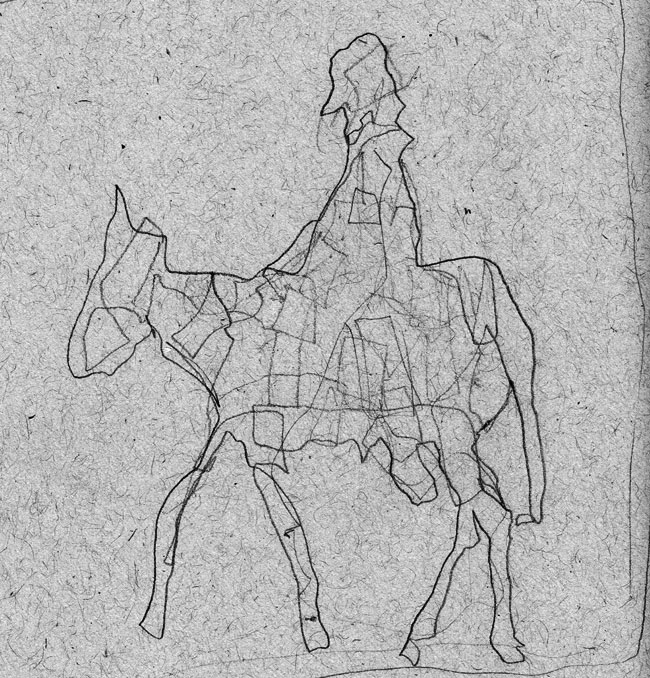
The drawing is from an earlier sketchbook, the likes of which I fill with both pictures and words as I go along. Thought you’d enjoy seeing one.

Just came across the following in the sketch book. I’d forgotten I’d done it, an abbreviation of the sayings of Jesus in one of his few sermons.* You might recognize them, or be reminded of the longer versions. In any case, though familiar, they’re pretty penetrating, and transformative if one puts them into practice . . . which, of course, is what he had in mind.

Be salt, don’t be tasteless.
Be light, don’t be dull.
Be good, and let God shine through.
Don’t hold anger,
and don’t label people “fool.”
Be quick to clear any grievances.
Be wary of lust’s lurking.
Cut out (or off) what’s causing habitual failure.
And don’t vow; your Yes or No should suffice.
You have an enemy? Try loving him (he’ll disappear).
Submit to his abuses and see what happens.
As for demands, do double what’s required, even if onerous.
Lend, and give to any who ask . . .
like God does, open-handed, regardless.
Do your good covertly.
Same with prayer, not for show . . .
plainly, with honesty, avoiding rote or method.
Pray God’s will, his worth-ship, the day’s provision, forgiveness,
and a protecting shield from the tempter.
Forgive any and all.
Fast, okay, but not for display.
Don’t be only preoccupied with gain, rather seek future treasure.
Focus on the invisible, the timeless.
Choose who you’ll serve . . . you can’t serve two.
Your Father is the better master.

Looking at this again I see I’ve left much out. His actual sayings, though also very brief, convey so much more. Still, any one of these could be a life-changer, and taken together, form a whole new person.

I’ll post the rest of this Sermon on the Mount Abbreviated another day.

Have yourself a good one today.


______________
* Matthew 5:13-6:24

11 Comments

Art and Science

March 10th, 2013

I’ve had a few things to say about art lately, and artists, and that everybody is one, one way or another. How much or how often I’ll blog on this topic, I can’t say. It does make a certain sense, however, this being a blog on an artist’s website. Today it’s a quick musing on the duality of art and science.

Let’s call them non-identical twins. Or the male and female that make up the whole of “mankind.” They’re opposites, and equally essential. Whether one distinction is more useful than the other at a given time depends on the time, the need, the role.

Moreover, they overlap, art and science. They often come together as part of a perfect solution. It’s the form and function working in harmony.

One of the definitions of a Renaissance man is a strong facility in both areas of art and science. It seems in that period they didn’t split things up into such specializations as we tend to today.

Leonardo da Vinci, the quintessential Renaissance man, was a masterful artist, but by his sketchbooks is known for his engineering imaginings, his inquisitiveness in botany, in human anatomy, geology, map-making, wonderful calligraphy (backward), writing, and a whole lot else. He didn’t seem to know he was supposed to be either an artist or a scientist. (Obviously not too smart.)

I read once that he entitled his book on art, The Science of Painting.*

The fact is, there is a science to painting (not all the way through, or we’d have every painting looking alike). But there is a procedure for starting out, for understanding color, for perspective in drawing, for proportion and design, etcetera, that if skipped over, is all too apparent.

And there’s an art to science. Even when all the predictable parameters are exhausted, there will still be the “unknown” where decisions have to be made by intuition or some other sense not in the text book. Consider: Medical arts. Happens in every field.

Once again, a quote from Art and Fear** helps us:

“The scientist, if asked whether a given experiment could be repeated with identical results, would have to say yes – or it wouldn’t be science.

“The artist, if asked whether an art piece could be remade with identical results, would have to say no – or it wouldn’t be art.”

If it’s repeatable, it’s science. If it’s not repeatable, it’s art.

So which do we do? We do both. One is emphasized over the other at certain moments, in certain occupations, and to satisfy certain needs.

And they overlap.

I can live with that. How about you?


____________
*      Unpublished. All of his writings were only in his sketchbooks.
**    Art and Fear, Observations on the Perils (and Rewards) of Artmaking, David Bayles and Ted Orland
*** Lecturing and demonstrating today in San Clemente. For details see bottom of last e-gallery.


5 Comments

You are an Artist

March 3rd, 2013

It’s the title of a book we bought used many years ago and have had around since. We took it with us to Oregon. Just the title is reminder of what we often need reminding of: You are an Artist.*

I’m aware that perhaps half of my readers will rise to this title, and the other half won’t relate. But wait.

Even if you don’t, for reasons cultural, or upbringing, or linguistic, you may want to reconsider. Here’s a great quote I used in the introduction to my book, In the Image of God:

An artist isn’t a different kind of person,
but every person is a different kind of artist.

That’s by Eric Gill, type designer, sculptor, graphic designer and part time philosopher a couple generations back. I remember his typeface, Gill Sans, one I often used in my years designing Surfer Magazine. I wasn’t aware its designer was active in multiple fields. Another Renaissance Man? His great quote indicates how he saw life, and all of its participants.

ALL of its participants!

Doing things from an artist’s perspective has to do with approach.

It’s aesthetic, perhaps, but more, it’s unique. It’s a way of looking at, of problem solving, of play. What it comes up with is original, new, and “just right” for the challenge at hand.

If done very well, it’s genius.

A more-or-less quote by Vincent Van Gogh (I’ve read all of his letters to his brother Theo but there were thousands) goes like this:

I’m an artist. By that I mean I’m always exploring, often not getting it, always working toward it.

There it is, an artist’s definition of an artist. We’d say, “Van Gogh thinks he’s an artist? Well, duhhh. He goes out every morning and paints another masterpiece by evening.”

Yes, but he wasn’t an artist because he used paint, he was an artist because of the way he used his mind.

There are a lot of people using paint who could use an extra surge toward becoming an artist. And there are mathematicians and plumbers who are very much artists.

So there you go. Remember Eric Gill: “Every person is a different kind of artist.” And remember Van Gogh: Keep working, keep exploring, try the new thing.

As you do that, you are an artist.


_________________
* You are an Artist, A Practical Approach to Art, by Fred Gettings, Pub. Paul Hamlyn, London, 1965
Next: the e-gallery, sharing some of the work produced in Oregon


16 Comments

A Personal Renaissance

February 28th, 2013

This is the last day of Anne’s and my art-making hiatus here in Oregon. Besides spending maximum hours in the studio, we’ve also had time for a bit of reading, a little writing, daily walks (rain or shine) a few excursions around the area and often an evening video. We’ve also frequented the library. Maybe more typical of a small town, they’ve let us check things out in spite of being out-of-staters and ineligible for a card.

Among the treasures we found was a 36-lecture series by The Teaching Company on the Italian Renaissance. (We noticed we were the first to check them out.) Those lectures afforded hours and hours of listening and half-listening as we worked.

I’m always amazed when exposed to such at how much has gone before us, how much of it I haven’t known, and how one person could have amassed so much about it.*

Besides the historical appreciation, and better understanding of how we got to be how we are, is the personal take. Each of our lives is in part a microcosm of the larger history. And we may well experience our own personal renaissance.

And that while holding firm to our faith, as many of them also did.

Some of the points that typify the larger Renaissance and our own include:

An appreciation of the value of ideas gone before
An engaged and active mind, and an appreciation for all learning
An elevation of beauty as a high value
The value of elegance in language
Of harmony between form and function in all things
Of architecture, including our own living space
A recognition of a strong economy to support pursuit and patronage
Of love as a general approach to life
A fostering of and appreciation for genius among us
And much more

In summary, some say the Renaissance rediscovered, reinvented and defined the autonomous individual, able to create him or herself according to principles recognized as good.

Seems good to me.

How about you?


______________
*The Italian Renaissance, taught by Professor Kenneth Bartlett, University of Toronto

7 Comments

Quantity to Quality

February 24th, 2013

FROM JOE, A READER:
Great words.
I paint for joy. For me, art adds to life. My life would be less without it.
An odd realization that I’ve had that you probably worked through years and years ago: If a piece turns out good, it becomes a part of me. I am interested in neither selling it nor giving it away. If it turns out poorly (right now, the ratio is about 3 of 4), I have no issue at all with painting over that canvas.
Hyatt, you are obviously part psychologist…so what does that mean? And especially from a Christian perspective.

Thursday’s blog on Art and Fear generated some good responses, including a question from Joe Black. Joe is a writer, a columnist, and a part time painter. He tells me he came across this blog sometime last year and signed on.

I’ve copied and pasted his comment at left. If I’m interpreting it correctly, he’s not interested in selling art but rather in finding his highest self (art-wise). He keeps the best and destroys (paints over) the lesser. He asks for my response, and from a Christian perspective.

The latter I’ll not touch. Who knows what the Master might say; Jesus’s answers so often unsettling and piercing into the motives of the heart. It seems to me Joe’s motives are plenty pure . . . not willing to release substandard work for any price, nor for that matter, his best work either. He paints for joy, and is rewarded about once in four.

Are the rest of them joy too, in the pursuit? We’d have to ask him.

There is certainly a chance that his success ratio will grow. Good art comes from making lots of art.

Here’s another quote from the book, Art and Fear:

The function of the overwhelming majority of your artwork is simply to teach you how to make the small fraction of your artwork that soars. Even the failed pieces are essential. The point is that you learn how to make your work by making your work, and a great many of the pieces you make along the way will never stand as finished art. 

The principle is the same, whatever our pursuit.

As far as wanting to keep your best pieces, I understand . . . but in time you may be willing to let them go (if there’s reason enough), as our own sense of “best” changes and grows.

Meantime, more power to you Joe.

By the way, I feel somewhat the same about these blog posts. Those I let pass I do hope reflect the inner me. The rest, I paint over.

But the whole process is a joy.

Hope you’re all experiencing that.


____________________
*  Art and Fear, Observations on the Perils (and Rewards) of Artmaking, David Bayles and Ted Orland

4 Comments

Art and Fear

February 21st, 2013

That last post, about our meeting and marriage, garnered so many loving comments, I hardly know what to write next. Happily, the best notes each of us received were from each other. The thought even crossed my mind to share those, but who would blush most, you or us?

We’re in Oregon, half way though our art-making hiatus. You’d think that would be fun, and an epitome of the free life. Both are true enough. Yet there’s something daunting about a blank canvas or sheet of heavy rag paper ready for ink or paint of some design, who knows what? Or worse, something intimidating about a piece of art half made, but the ongoing touches/strokes/designs/colors not at all clear.

There are moments of exaltation when something seems to be working, but one can also feel like a failure several times in a day. The canvas, like life, doesn’t always make clear what it needs to succeed.

I go to the Scripture, hoping for guidance. There’s David in Psalms calling out for guidance. Do answers come? We can assume so . . . but then there he is again in the next psalm, calling out again.

Still, his confidence doesn’t altogether lag . . . not in life, not in God.

Art-making, you might think (or I might think) is one of the least necessary things in life. Yet it is so like life. I’m reminded of the famous chess match between Boris Spassky of Russia who said “Chess is like life,” and Bobby Fischer of America who said “Chess is life.”

So it is for some of us with art.

And we sense that God would see it that way too.

So we go on. Sometimes in free abandon, and sometimes working it out in fear and trembling, feeling very alone.

There’s a book, Art and Fear, which Anne and I have often referred back to for its depth of understanding and pithy aphorisms. I was asking her about one of the quotes the other day, trying to get it right. “Why?” she said, “You don’t have the problem.”

Ha, do I have her fooled!

Here it is:

“Fears about yourself prevent you from doing your best work…
while fears about your reception by others prevent you from doing your own work.”
*

Did I not tell you art-making is like life? These fears inhibit on every side if we let them, and in every area. Art is life.

And living it is an art.

“Be bold and courageous.”** That’s another from Scripture, spoken by God himself to Joshua, now on his own after Moses’ passing. That’s the word I’ll take today, faced with all these blank or half-filled canvases.

And that’s what I’ll pass on to you. Which one of us, whatever the art form of our lives, hasn’t much to overcome?

Don’t quit. Seek guidance. Keep painting.

Whatever “painting” means to you.


____________________
*   Art and Fear, Observations on the Perils (and Rewards) of Artmaking, David Bayles and Ted Orland
** Joshua 1:8 (long a favorite)


23 Comments

Those Three Little Words

February 17th, 2013

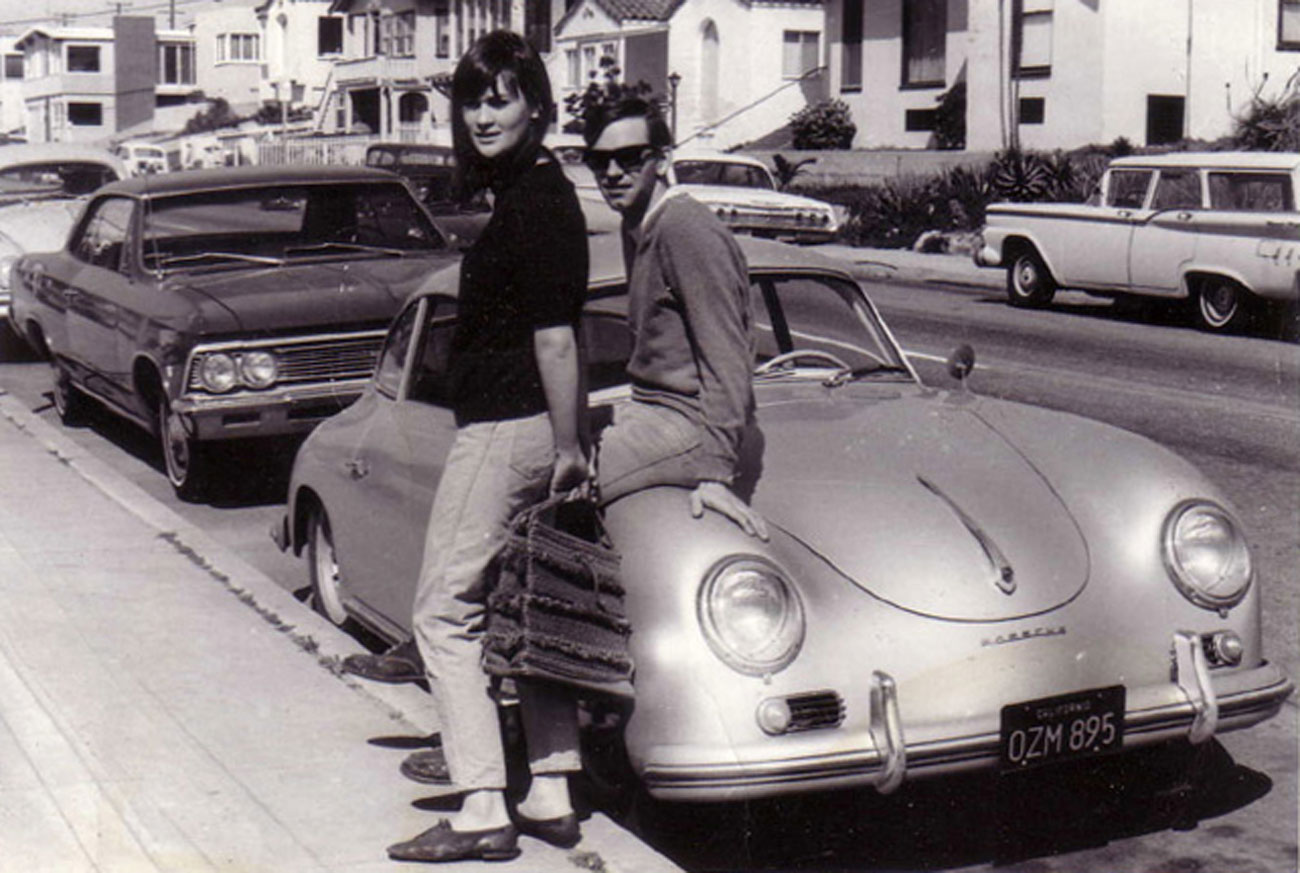
1966, the first year of our marriage, already back from Georgia, in Hermosa Beach, California. Click for larger view.

It’s Sunday, and I usually post these on Monday, but this is different: It’s our anniversary.

I’ll never forget those three little words Anne said when I suggested we get married: “I guess so.”

We’d met years earlier. I was flipping hamburgers at a drug store fountain and she was friends with the dishwasher. We went out a few times. Then she went off to college and I went hitchhiking across America and Mexico . . . just because. There’s more to the story, but I try to keep these posts brief.

Later I was back in school, though with no particular direction. Through a series of driving incidents (too much sport, like I was a cowboy and my cars were bucking broncos) my license was revoked. Anne’s father owned a car dealership, and she had a car. Again, there was more to it than that, but it helped.

After that we remained close. Then I got a job offer that would take me across the country. It was to start in two weeks and I had to make a decision. That’s when I brought up the idea about marriage.

Her “I guess so” was enough; we started making plans. There would be no time to marry in the week before leaving so we’d tell our parents our plans to get married after moving to Georgia. You can imagine how that idea hit with them.

(I used to tell our children, “Please don’t do this to us.”)

My parents hardly knew Anne though could see quality. My mother, however, wanted us to marry “here,” in California. “There’s no time,” I said, “we’re flying on Friday.”

“You can get married on Thursday,” she said, always practical.

“Not in a church,” I protested. But she’d hear none of that. The fact that I’d long since broken out of that pasture didn’t mean the marriage of her first son (of five children) wouldn’t be there. She said she’d organize the whole thing; all we had to do was show up. She’d even iron a shirt for me. I figured it was the best offer we could ask for and agreed.

Upbeat, we went off to tell Anne’s parents.

They weren’t as elated.

Where had I come from, who was I, how much money did I have?

Happily I could answer that one. I had $800. It was the first time I could have said that. I don’t remember them being very impressed.

But they blessed us the best they could, hosting the reception at their house. I remember meeting friends of Anne’s family that evening. They’d known Anne growing up and gushed over her qualities as a person, something I heartily agreed with. Later I learned they’d been going up to her and saying, “Well, good luck.”

We left the next day for Georgia, a new location, a new job, new friends, our new life together and, for me, a new driver’s license.

That was 47 years ago today.

It was a house built on sand and it may well have collapsed had not the Master Builder entered in, some five years later, and shored up foundations. But like I said, I try to keep these brief.

We’re still enjoying each other’s company, still making trips hither and yon, our five children happily all well established (also hither and yon) as are the 15 grandchildren. Our wealth is our family, and our friends.

As for the money, there’s never been a lot, but always enough. Eight-hundred dollars can go a long way.


________________
PS For last year’s anniversary post, reviewing the years, click here.


50 Comments

You Could Become a New Person

February 14th, 2013

Hi Blank Slate readers. First, thanks again for being along. Last post I said we were/are at a new blank slate place, waiting for the next theme to present itself. A number of ideas have surfaced, but so far each has been pushed back down. So it is with the creative process: There’s rarely a shortage of ideas, but the right idea for the right time, that’s where the discernment gene comes into play. We can all be grateful for that one.

Happily, here at our Oregon retreat, the painting has been going great, as is Anne’s printmaking . . . the real reasons for our being here.

But it is Thursday, Blog Post due date (along with Mondays). So here’s a piece I recently came across in an old sketch book. It’s dated 9/10/96 and noted, “En route to Grand Forks.” I remember the moment. I had just been relieved as president of Wycliffe Bible Translators, USA, but was still serving. I was on an airplane, on my way to a speaking engagement in North Dakota. I wrote the following:

You could become a new person . . .
Another person in the same body
With half a life yet to go
(less than half in years,
but the track possibly faster,
what with experience and background).

You could subject yourself to new environments
Deeply . . . not with camera or writing pad
like in documenting or reporting on,
But living in . . . adopting . . .. becoming.

You could go back to school
This time to learn not a craft or a head start
But a life
That thinks another way
That sees another side.

You could find a mentor
Live in another culture
Read books that have never been on the list.

You could, before the Lord, determine to live like him
To give up all claims to self
Work out your own salvation with trembling and fear.

You could do it soon . . . whatever it is . . .
Because if you wait
it will be
too late.

That was it. I forgot I wrote it. But in fact, it’s been script for pretty much what’s happened. Well, the spiritual parts still flounder, God knows. But much of the rest has proceeded apace.

And there’s opportunity to do so again, starting from here.

For you too.

Life is short, but long enough to get in a number of lives.

Let me know if you agree.

13 Comments