Try Things–You Never Know

January 22nd, 2012

Here’s another bit of clear wisdom that, once discovered, became a basic approach for how to live life. That’s in spite of not always knowing the clear way forward (which is a lot of the time).

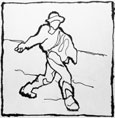
Sow your seed in the morning, and at evening let your hands not be idle,
for you do not know which will succeed, whether this or that, or whether both will do equally well. Ecclesiastes 11:6

There it is, from the highest authority. We’re advised, even exhorted, to get into action even though all we have is blind faith and an idea. Or are conflicted between various ideas.

There are no promises in this life for 100 percent success every time. That’s what we’d like. Somehow we think God should give it to us. Particularly if we’re friends. But that’s not how this scripture says it works.

Rather it says, “Try things. Try multiple things.” If they all work, get ready for time management.

There are no guarantees but one: If you do nothing, nothing will happen.

Somehow knowing that life is a big experiment is liberating, even exhilarating. I don’t have to wait until everything is perfectly lined up, all the questions are answered and I’m good enough, smart enough, rich enough, confident enough. If I’m always waiting for all that, it could be all week before I do something, or all year.

Or all life.

God created human beings, not automatons. And here He’s calling us to remember that. We’ve been given brains, emotions, and wills. We’re not just subject to instincts. That’s for the animals. They just do it. No decision. (Or indecision.) We, however, live in a less sure landscape. Ours is to use the head, explore the options, and then move out . . . in one direction or the other. Or both in their time.

We can’t know how it will go; and that’s a beautiful thing to know.

We’ve been given permission–even admonition–to experiment, to explore, to initiate, to delve.

If we try enough things, something’s bound to work. Even stumbling along is progress.

Without the sails set, the rudder is useless.

So, what is it that’s been in your mind to do but you haven’t for one reason or ten? That’s a seed. It’s the Author of Life that’s telling us to get that seed in the ground . . . in the morning. Then get another in the ground in the evening. You don’t know which will take. In time you could have a garden, or an orchard.

Or the whole North 40.

Let me know what you think . . . and in time, what happens.


_________

Next: “On Not Seeing the Future.” Coming Wednesday (trusting it’ll come).

Feel free to share with a friend.
15 Comments

The Entabulator

January 20th, 2012

Last Friday’s blog, “Gobbledygook and E-mail Disclaimers” got a lot of laughs. One friend responded with another, “The Entabulator.” By the time I watched it a second time I was laughing already at the anticipation of the language. By the third time I was beginning to incorporate his words into my vocabulary. I’d better stop there.

Here it is, with the (true or not) two paragraphs of intro sent to me:

Many years ago, Rockwell International decided to get into the heavy
duty automatic transmission business. They were preparing to tape
their first introductory video and, as a warm-up, one of the stage crew began a monologue that has become legend within the training industry.

This man should have won an academy award for his performance.
Now keep in mind, this was a rehearsal for camera, lighting, and stage crew, and he had no script! This is all strictly off the cuff, nothing is written down, and nothing he says is true. It’s just meaningless drivel made up as he goes along.


BTW, If you missed the Gobbledygook and e-mail Disclaimers, or want to see it again, you can click on it at right.

And, keep laughing. It’s good for your bones.


_________

Next: Try Things–You Never Know, coming Sunday.

Feel free to share with a friend.
9 Comments

Hurdles Happen

January 18th, 2012

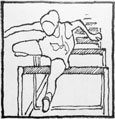
You’ll find, whenever you’re trying to get anything done, opposition will rise up in your path as sure as weeds in a garden. It can be especially true when the thing you’re doing is the right thing to do. If you don’t want any opposition, don’t attempt anything.

Hurdles happen. It’s a fact of life. But maybe they’re there for our own sakes. Maybe they’re all about testing our resolve. Or to fine tune the approach. Or to sharpen the idea.

The “Nos” on the track may only be resolve-testers toward the eventual “Yes.”

Hurdles happen. But most of the time they’re just hurdles. They’re not the Wall of China.

Another irony, the would-be roadblocks are often set up by good people, even our friends. We take that hard, but it happens.

Friend Peter said to Jesus, “That’s not going to happen to you,” to which Jesus replied, “Get behind me, Satan.”

Whoa!

Friends mean well; maybe they just don’t see the whole picture. And the only way they’ll be able to ever see it is for you to do it, build it, speak it, and let the proof be in the proving.

One difference between us and Jesus, you’ll say, is he really did always know the right thing to do and the right way to do it. Maybe we’re not so confident . . . of our ideas or our motives. Okay, these need to be checked. But even then, depend on the hurdles. They will come.

One thing about hurdles: They’re on the track. If you get off track, you won’t encounter them anymore.

Another thing: Hurdles are set at just about the right height to barely scale. Once you can routinely handle those, they’ll be adjusted to a higher notch. Bigger people get higher hurdles to start with. (Jesus’s was the largest of all.)

Hurdles happen. But just because they do doesn’t mean you’re supposed to quit. Quite conversely. They are there to test who you really are.

Hurdles happen.

Keep running.


_________

Next: Another zany post: The Entabulator, coming Friday.

Feel free to share with a friend.
 

14 Comments

So, Go, says God

January 15th, 2012

Here’s a philosophy of living from one of my favorite quotes:

Go, eat your food with gladness, and drink your wine with a joyful heart, for God has already approved what you do. Always be clothed in white, and always anoint your head with oil. Enjoy life with your wife, whom you love, all the days of this meaningless life that God has given you under the sun—all your meaningless days. For this is your lot in life and in your toilsome labor under the sun. Whatever your hand finds to do, do it with all your might, for in the realm of the dead, where you are going, there is neither working nor planning nor knowledge nor wisdom.
–Ecclesiastes 9:7-10

There it is, an overflowingly positive passage right in the middle of life-in-the-pits by the Ecclesiastes preacher, the dooms-day teacher. I confess I tend to ignore the “life is meaningless” parts. I substitute it with something more like life is hard to understand. I can understand that.

But I really rise to the permission, yea, the admonition, to live every tick of the clock with all I can put into it and all I can get out of it. Especially knowing that clock is running out.

Go, he says. Go with God. Via con Dios. Go, for God is always going, always moving ahead, never back. He’s growth oriented, loving his own invention of time, of which he will never run out even if we will and we never know when.

Meantime, enjoy the basic necessities, like eating and drinking. Do them with a smile ready at the cheeks of the heart.

Go. Get up. Do something. Consider yourself already favored in the opportunities laying before you. Okay, not every one can win at every thing every time, but just being in the game is rather special.

Go. Get up. Get dressed. Dress in a way fitting with who you are, favored. By God. By God! It may all not matter much ultimately, what you put on, what you wear, but why not enjoy it? Dress the part. It may be just a bit part, but play it well.

And your spouse . . . the one you’re used to after these long years; s/he’s still worth your joy, and at moments, the highest joy! (Smile.) Keep love alive. Keep joy alive. All moments matter.

And about work . . . okay, so you have to do it. What else are you going to do with your time? Meaningful work is a gift. If it isn’t meaningful, make it so; or find something that is.

So, “Go to work,” says the preacher. And whatever that work, do it to the height it can be done by you. Test yourself in this. It’ll make it more fun.

That’s it. A simple philosophy, straight out of Scripture, sanctioned by God.

Okay, there’s more. Much more. But I like this little gem sparkling in the Ecclesiastical rough.

Ours is to remember it, to run with it. To know that it’s all a gift.

Why not enjoy it?

Amen?


_________

Next: Hurdles Happen, coming Wednesday.

PS Haven’t subscribed? You can do so with a quick click in the right column and never miss.

And feel free to share with a friend.

11 Comments

Gobbledygook and e-mail Disclaimers

January 13th, 2012

Did I say all these posts would be pertinent? If you think they always should be, skip today’s.

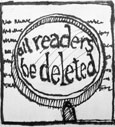
Have you seen those notices that sometimes come at the bottom of e-mails? They’re typically from big companies or accounting agencies, the kind who hire lawyers and have to keep them busy. And they’re filled with gobbledygook (a second language requirement for law school) and intended, apparently, for keeping the “wrong people” from reading the information in the e-mail that’s just been sent. Of course, by the time you’ve read it, you’ve read it. And if you’re not the right person, then, well, you may be in some sort of trouble. Someone sent it to you, but they’re not liable, they’re innocent. You as a person, however, could be deleted.

In their defense, most senders probably don’t even know these disclaimer’s are part of their e-mails, attached as they are as a standard template from the corporate office.

But just to be careful, I’ve come up with my own. And though I can’t afford a lawyer to really dress it up, here’s my take. Feel free to use it on all your official e-mails. Or write your own. (I take no responsibility.)

By the way, I’ve tried this out on a number of personal e-mails to friends. To date, none have remarked on it. Perhaps we’re just used to ignoring the small print. Or perhaps it’s just unremarkable.

Here it is:

LEGAL NOTICE: This e-mail is intended for the specifically named recipient (herein named, “recipient”) and has been sent by the also specifically named sender (herein named, “sender”), and no other sender, meaning there will be no other sender implicated in having sent this particular e-mail, and if there is some other sender implied (implicated) then we, the sending agency (“sending agency”), will not be held responsible. Nor is this e-mail to be used for any purpose other than that for which is was intended, namely reading; and if the specific recipient does not read it, we (the above named “sending agency”) cannot be held liable for that either. Habius corpus, status quo, and bona fide. If in the case of multiple recipients, then the reading may be carried out multiple times. This holds specifically for those in the primary address line as well as those in the cc (carbon copy) line. Any in the bcc line will be exempted for reasons that will be obvious to the courts (see sec. 1227-a, “E-mail Protocol, Procedures and Publishing Pamphlet) (E-PPPP). Otherwise all compliance with this paragraph will be expected in due course, due process, due season, and by due diligence lest it be deemed past due and the dude be in deep due due. Habius corpus, sine pro quo, etc. If the specific recipient does read, or in the case of multiples, do read, or at least one of the multiples beside the prime addressee (“prime addressee”) does read this e-mail (bcc recipients excepted) according to the purposes for which it was intended, namely reading, then that recipient (or those recipients) is (are) invited to respond. Please be brief.

Feel free to comment.


_________

Next: “Go,” God’s instruction to us, the living, coming Sunday.

PS Haven’t subscribed? You can do so with a quick click in the right column and never miss.

And feel free to share with a friend.
12 Comments

Guidance and the GPS

January 11th, 2012

If I get off track, can I find my way back?
Yes, but back is not where I’m going.

Okay, but will the wrong road get me there?
No, but by it you I can still find the right one.

I learned these things again lately in England. Anne and I were there traveling around. Sometimes around and around and around—if you know anything about those round-abouts. Happily we had the use of a GPS (Global Positioning System), an ingenious devise of our times to keep us from ever getting lost again. In England it’s called a Sat Nav, for Satellite Navigator. And being in England, the automated voice was one with a delightful English accent. We came to refer to it has “her” and considered her our friend, and sometimes savior.

Once, on that first experience we selected “most direct route” thinking that made more sense than, say, “fastest route.” Following the map on the little screen and the pleasant woman’s voice, we found ourselves on a hedge-lined “road” about the width of a driveway to a single car garage. And it was a two-lane road! Actually, parts of England are full of these but we didn’t know it yet. Having no choice anyway, we went along for the adventure of it all and were delighted, and even surprised, when in time we were emptied out onto wide streets of the town we were seeking. That’s when the little device really earned our trust.

Earlier, however, we were on another road and encountered repair work, preventing forward progress. We turned back. The lady in the box kept coaxing us to turn around at the earliest convenience. We protested, but she was adamant, so we turned the device off and started asking directions. That’s when the adventure really increased. People didn’t recognize the name of the place we were looking for (or maybe us, with our American accent); one would suggest one thing and another another. Finally, just to try it again, we turned the GPS back on and started receiving directions again. We followed them, albeit sometimes over wagon paths and through deep shady hollows. We eventually came out to light of day, and, WOW, our destination!

I was slowly beginning to realize that this guidance from the sky knew things I didn’t know. By our first programming it in, it knew where we were trying to go, where we were, and had various options to get us there. And if we got confused, took a wrong turn, and couldn’t retrace our steps, it knew how to direct us, even now from this new starting place.

It’s something I’ve learned more than once, and I suppose will keep learning. I get off on the wrong road, make less-than-wise decisions, even lose track of where I was going. But the damage isn’t permanent. It may not even be damage. My route may be slower, but it may be more scenic. It may be frustrating, but it may contain more learning.

I have a GPS wherever I go. And I don’t even carry a unit. Of course I substitute the first initial for a different “G” word.

The guidance comes from the sky.

It knows where I’m going.

And it has a way—various ways—to get me there.

All I have to do is trust.


_________

Next: Gobbledygook and e-mail disclaimers, coming Friday.

PS Haven’t subscribed? You can do so with a quick click in the right column and never miss.

And feel free to share with a friend.

7 Comments

Letters from God (dropped in the street)

January 8th, 2012

I confess I know Walt Whitman’s works only by occasional quotes. One, however, has inspired my long agreement. Here it is:

I find letters from God dropped in the street,
and every one is signed by God’s name,
And I leave them where they are,
for I know that whersoe’er I go
Others will punctually come for ever and ever.
–Walt Whitman, Song of Myself, Sec. 48

What experiences he had that convinced him of this truth, I cannot say. I do like the way he put it. Like a poet would. That’s what poets do: They put the commonplace in uncommon language and we see it again for the first time. Different. New. Better.

It’s like it dilates the eyes and we take in more light.

But what are these letters? Hints for guidance?

That’s something that we care about quite a lot. What to do? Which direction to take? How to get there? And where, exactly, are we going anyway? Mysteriously, the solution is very often very near to the problem. At least the next step is. In most cases, it’s the question that needs clarifying. Then the answer will appear. And it can appear in the most mundane places. (If there is anything mundane in our universe.)

Or was he referring to provision, that which comes when we need it? There’s a truth in that, too. But no, Whitman was always poor, and it’s unlikely he would have said, “And I leave them right where they are.”

Maybe it was just evidence. Evidence itself refreshes our souls . . . evidence that there is a divine hand, guided by a divine eye, and a divine hint-leaver that lets the observant know that s/he’s not alone.

Another said it more plainly. “Ask, seek, and knock; the rest will happen.” Believe it.

And, if the problem is belief, then start with that. The rest will come.

Punctually, for ever and ever.


Next: More on guidance . . . and the GPS, coming Tuesday.

PS Haven’t subscribed? You can do so with a quick click in the right column and never miss.

And feel free to share with a friend.

3 Comments

A Line from the Wit Man

January 6th, 2012

I’ve read almost nothing of Walt Whitman’s poetry. It was controversial in his day and he meant it to be. He was picking up on Ralph Waldo Emerson’s challenge that somebody should be writing some new sort of poetry that would be uniquely American. In any case, he wrote, and wrote, and wrote. Basically self-educated, he read a lot, and then wrote whatever came to him, from his own perspective and his own unversed free style. He’s mainly known for his Leaves of Grass, a compilation of poems he kept adding to throughout his life.

That’s what intrigues. It isn’t one long poem, though that notion intrigues too, but rather a continual adding to. It’s an ever-lengthening life message. I may have it wrong. Some Whitman scholar may want to straighten me out on my exposition, but that’s how I like to think of it. And I think Walt would allow me my personal perception since personal perception was what he was all about.

The title is telling, “grass” then being the pejorative among publishers for literature considered light weight and not worthy of much. Maybe mowing. Leaves, of course, could be the pages they were printed on, or blades on the lawn. But he took his thoughts, and maybe all thoughts, quite seriously. One of his lines tells it: “I believe a leaf of grass is no less than the journey-work of the stars.”

And there’s room for infinitely more, both grass and stars.

I warm to the notion of the life-long poem. There’s room for it . . . just as much as there is room in the world for every inhabitant. Whether it’s free verse or measured, it’s the ever-developing message of a life, artfully lived and purposely expressed that makes the poem. That’s not to mention of the plethora of thoughts. Some write it down, most just act it out; either way, it’s poetry . . . or can be.

Whitman said it: “And your very flesh shall be a great poem.”

Like with grass and stars, there’s always room for another poem. Including one that’s life long.

It should make for good reading.

Write well.


Next: One of Whitman’s lines that’s useful for all, coming Sunday.

PS Haven’t subscribed? You can do so with a quick click in the right column and never miss.

And feel free to share with a friend.

3 Comments

A Wish for Less List

January 4th, 2012

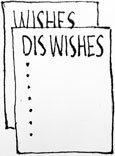
On January 1st I referred to last year’s (and now this year’s) resolutions. It was a list of qualities I could wish for more of. But I could just as well come up with another I’d like less of. I could call it my non-wish, or unwish, or antiwish list. It’d be made of us stuff I tend to have but would be better off with less of. If it was only that easy I could just name it and disclaim it!

Or take the stuff that sullies and put it in my dis-wisher.

Everyone’s list would be different but a few suggested options for me would be:

Poverty of spirit

Poverty of any kind

Underconfidence

Overconfidence

Preoccupation with self

Preoccupation with anything

Considering the old days were better

Considering the old days were failures

Any ingratitude

Any entitlement

General inattention

Mental myopia

Insensitivity

Dullness of mind

Dullness of any kind

Tomfoolery

Dick and Janefoolery

Insertmyownnamefoolery

I could go on, and so could you. (Feel free to comment.)

Here’s another that could summarize the whole thing. I heard it a few months ago at a funeral of a man who had been our pastor in the early years of our spiritual development. His teaching and example always held a place of honor with me. At the funeral, a distant niece of his had mailed over a personal eulogy which was read aloud. In it she enumerated a long list of his qualities, all of which were right and true, but one, buried in the list, stood out with me particularly: “He was never small.”

Never small!

What a wonderful thing to have said about you, even when you’re dead. Better when you’re still alive.

So I add it to the list.

Smallness

Smallness of thinking

Smallness of any kind

In this inner game of baseball, these are the balls not to swing at.

Why strike out needlessly?


Next: Thoughts on a life-long poem, coming Friday.

PS Haven’t subscribed? You can do so with a quick click in the right column and never miss.

And feel free to share with a friend.

11 Comments

Moore Resolutions, Last Year’s and This

January 1st, 2012

Dear Blank Slate subscribers and guests, greetings of the new year to you. And thanks for signing on. There are some 75 of you at this moment, and you can consider yourselves from here on as “signature members.” We’re friends, for sure, and will become more so. If nothing else, you’ll be providing for me a sense that I’m not writing into space, but in fact there are readers out there, thinkers and fellow travelers. Of course, any response will always be welcome.

So here we go.

It’s January 1, the traditional day of new resolves, that is if we didn’t know ourselves too well. Still, it is a day of new hope, and why not give ourselves another chance, and the new year a chance to see what it can do for us, or us for it. If our resolves don’t last, well maybe even a short-lived effort is better than none at all.

But before jumping in with wild abandon like a kid from the high board, eyes closed, pinching nose, I’m remembering I must have done this last year. Did it make a splash? Did anyone notice? Or did I just end up with earaches, like me at age seven and eight after summers at the municipal pool in Milwaukee?

I check and sure enough find a file called “Jan. 2011—Looking back, Looking forward” dutifully done this time last year. I find recounted a few reflections on the year before and then some aspirations for the new. I went with my surname as a guide.

Here’s the list:

More heart, more spirit, more focus, more verve

More laugher, more hope, more living in the moment

More giving, more loving, more water-spread bread

More prayers, more hearing, more keeping lines open

More sowing, more growing, more living to the full.

Basically more of all that matters, living up to the name.

There it is, a little soliloquy authored by me, addressed to me. I remember writing it now. I don’t remember doing it. At least not more. But then, that’s the trouble with that word: It’s open ended.

In any case, I think I’ll hit it again. I’ll toss the same ball in the air and take another swing. We may be the only ones in this game, playing against ourselves. But still, it’s no fun hitting dribbles; better to try hitting it out of the park.

Write your own list. Or use mine. Paste it on your refrigerator, or your mirror, or your door to the outside world. If the resolves only last a week, it’ll still be a better week. And if some of them stick for a year, it’ll be a better year. It’ll be a HAPPY new year, indeed.


Next: Some things we want less of, coming Wednesday.

PS Haven’t subscribed? You can do so with a quick click in the right column and never miss.

And feel free to share with a friend.


8 Comments