We Will Never Fill Up

August 2nd, 2012

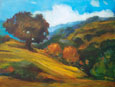
California Someplace, click photo to view. Reminds that I’m conducting a Landscape Painting Workshop tomorrow and Saturday, with still time to sign up here.

The eye never has enough of seeing,
nor the ear its fill of hearing.*

We just returned from travels and our days have been so full since, it’s like we were never gone. It’s a gift, really, a full life. There’s enough to do every day, every hour. We’ll never get it all done, or get it all in.

At best we come to little levels of  “enough for now.”

It’s rare when we climb a mountain that another doesn’t come into sight.

Before we even returned from our last trip we were talking about our next. Pre-dawn jet-lagged waking from sleep offers opportunity to get something else “done.” (Like writing this.) Every day has its focus. Then there’s a plethora of other, some left over from the day before, and some coming up but already demanding mental time.

Besides that, we’re passing by things on every side that are so interesting they could involve another lifetime of attention if we had it.

Something I’ve long said to myself: “I thank God for eternity when I’m running out of time.”

In a sense, we’re already connected to the infinite; that’s why we even think like this. We know that there is always more, more, more . . . and we’ll never have it all, see it all, hear it all, think it all.

Our Ecclesiastical sage cited this as just another vanity, but the same thing can be seen as another gift.

Once, deep in rich conversation with a good friend, we got interrupted and had to quit. “We’ll finish this later,” he said, then added, “We’ll never be finished.”

I loved that. And though distance has separated us, when we do meet we pick up right from where we were. We’ll never be finished.

Friendship, beauty, music, even our “to do” list, these are things that will never be complete. Not completely.

There’s always another mountain, but we can only climb one at a time. And the one we’re on is likely the one we were hoping to be on when we were on the last one.

So climb it, love it, and take in what you can.

Eternity’s coming.

Meantime, time is gift enough.


___________________________

* Ecclesiastes 1:8b

Next: A Handfull with Tranquility. Coming Monday.
11 Comments

Family Riches

July 28th, 2012

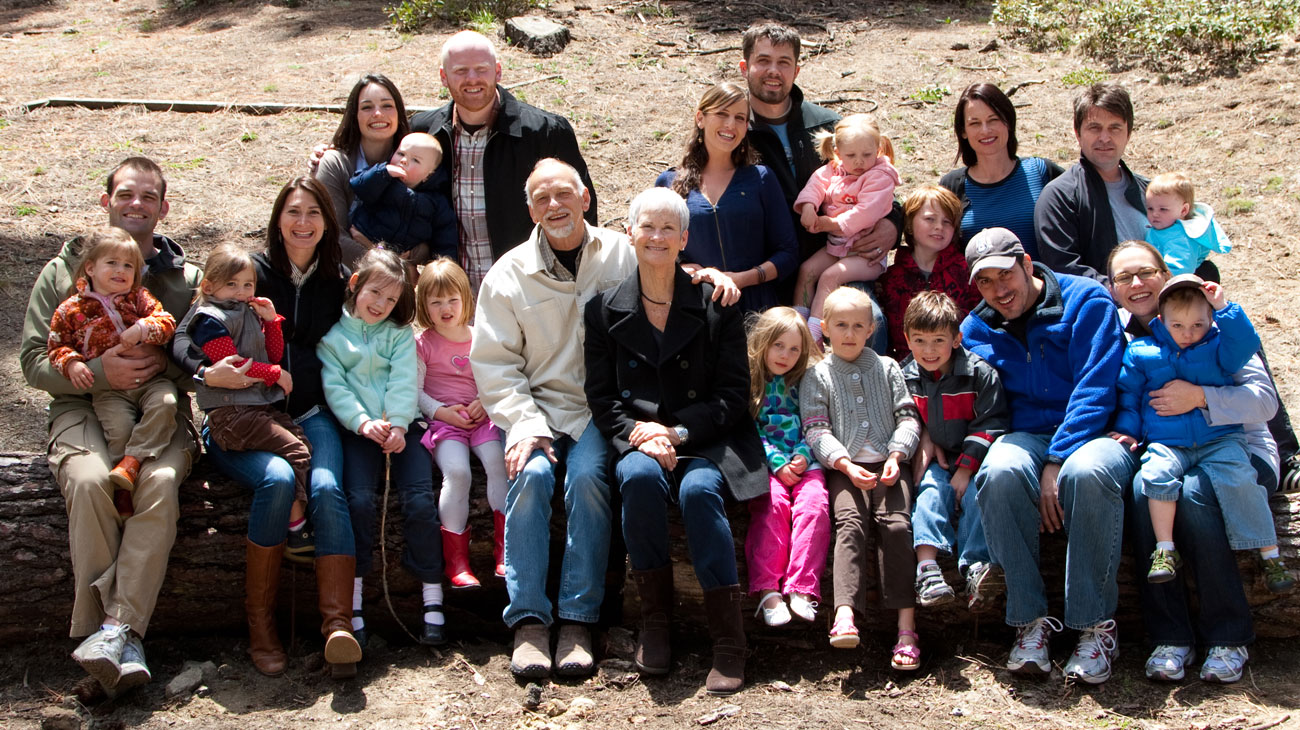
Here are the riches at Tahoe last year, with increase continuing since. Click for larger view.

We’ve been in England. It could be our last trip there; one never knows. We’ve been many times, but the last several have been to visit daughter Allison and her family. In the fall, they’ll move to California.

Whether we went for the sake of place or to be with family is a question. In truth, it was a little of both, but the family part added the richness.

We took a road trip to Scotland. The weather cooperated mostly. We had rain, but with two-year-old Justine in the car, we carried sunshine with us.

She’s one of 14 such grandchildren we have spread around a wide geography. Next month Anne will go to welcome another, in Chicago.

It’s all a growing return on earlier investment. Now to see them, we scrape our pennies together to go and visit our wealth. Or they travel to us.

Last year we gathered together in a nine-bedroom house built into the side of a hill at Lake Tahoe. That’s how we have to do it these days, what with our overflowing abundance.

The deeper appreciation of family is something I’ve noticed in my dad in these later years. In September he’ll be 96, with my mother right behind. He’s always been an active man, interested in many things, happy, but not particularly sentimental. Now it’s family that provides his main meaning. My father has never had wealth, but there’s always been an even contentment about him, and still is.

It’s the opposite to the tragic description here:

There was a man all alone; he had neither son nor brother.
There was no end to his toil, yet his eyes were not content with his wealth.*

Flying back over the Atlantic I took in an old classic, The Godfather III. I couldn’t help but note the summary by the rich and aging Michael Corleone, “The only wealth in this world is children.”

I realize those without children can still find plenty of meaning. But for me the longer I live, the richer I’m becoming; and the day that I die will be my richest of all.

There’s a great contentment there.


________________________

*Ecclesiastes 4:8

Next: We’ll Never Fill Up. Coming Thursday.

8 Comments

A One-Word Summary

July 26th, 2012

We’re in Edinburgh, Scotland. Because of it I thought I’d say something pertinent to that. And we’re still in Ecclesiastes, so I wanted to say something pertinent to that, too. But what?

First, though, I must confess my utter surprise at what I saw today. And with that, my utter lack of knowledge of what I might see.

It was our first time to Scotland. I’d been told its beauty is legendary, and many told us to see Edinburgh. But nobody told us why.

Sure enough, we drove through majestic countryside occasioned with charming structures and sheep dotted hillsides. Then we hit Edinburgh and promptly got lost. Before we finally found our destination we saw a lot of what seemed like a nice but not that extraordinary a city. We checked into our lodgings and ventured out on foot.

We headed toward the castle thinking that might be quaint. Wow, was I overblown! What we saw was not only magnificent; it was over the top colossal, huge, spread out, and full of history. And the whole area was full of people. Tourists from everywhere crowed the streets. It was another message to me about how little I knew that others apparently did!

In the end it was my own naiveté that struck me as the thing most amazing.

To take in as much as we could in our limited time, we hopped on a tour bus. Double decker, with guide, in English (well, Scottish). My amazement continued, now with how much history has taken place in these precincts and again by how little I’ve known of it. And that’s with me loving history!

It was a great day, taking in sights, marveling, hearing about all the exploits that had gone before, wise and foolish. But what to equate it with in terms of Ecclesiastes?

Vanity?

“Vanity, vanity,” says the Preacher, “all is vanity.”*

Sorry. That’s all that came to mind. It’s a summary of the human state, before and present. But I must confess I love it all. Don’t know what that says about me, but today we’re going back for more. After that I’ll get a book.

There’s so much vanity to know.


_______________________

*Ecclesiastes 1:2

9 Comments

Rebuke’s Gift

July 22nd, 2012

Encounter, detail.

It’s better to heed a wise man’s rebuke than to listen to the song of fools.*

“Praise shames me, because I secretly crave it.” That’s by Nobel Laureate Rabindranath Tagore, but I suppose it could be said by any one of us.

And we could add, “A correction shames me, because I secretly avoid it.”

Praise, deserved, is a high thing and should be accepted with humility. For real value, it needs to come from the discerning. Cheap praise is just that.

Either way, it’s like perfume; you can smell it but you’d better not swallow it.

But “rebuke,” you’ll say, is not just correction, it’s correction with a point. It smarts.

And it’s smart to accept it.

I looked up the etymology. It’s from 14th century Anglo-French meaning to repel or beat back.

We knew all about rebukes when we were children and we were generally helped. It’s a rare thing among adults. We build moats and walls around ourselves that prevent any such from getting through.

But there may be times when a big “STOP IT” would be the best thing for us to hear.

Stop it?

Yes. Stop it. Whatever it is you’re doing that’s annoying, festering, bringing people down, or bringing yourself down: Stop it.

Sorry if I’m intruding, but I couldn’t resist since we’re on the topic. I know I need to hear it from time to time.

Take it as from a friend . . . just in case it applies and there’s no one around with the blundering forthrightness (or the courage) to say it. If it doesn’t apply, save it for another day.

Or, just forget it.

I think I hear the singing of a fool. (Much more pleasant.)


PS  Click here for Bob Newhart’s classic counseling session where he gives the same advice.

_______________________

*Ecclesiastes 7:5

Just entering the Lake District, England.


10 Comments

Nothing New Under the Sun*

July 18th, 2012

Here’s one of the Ecclesiastical truths that’s most prominent and most hard to understand or accept.

Could it be that he lived so early that nothing yet had been invented?

But what would that say about the iron age, the bronze age, the age after age of magnificent architecture, and accumulated wisdom the likes of which the world has hardly seen since?

And maybe that’s the point. The principles have been laid down from the beginning, the world runs on a certain course, all is governed by certain laws, and nothing will ever be added to it. Anything that follows is only further discovery of what has always been.

That discovery, however, has kept minds busy for generations, with certain spurts at certain times and places. We like to think we’re in one now, evidenced by many things, particularly science breakthroughs and technological innovations. But the principles have always been here.

Take this typography we’re using to communicate with. It’s nothing but a bunch of pixels arranged and communicated electronically over airwaves that have always been here. The prototypes of these particular letters were first formed by the Greco/Romans and their predecessors devised from earlier alphabets in various languages.

A lot of this is traceable in history, like the approximate date of the first alphabet (around 1500 BC), or in pre-history, like the first division of languages from one. But before that? Well, man’s been communicating from the beginning, and there’s nothing new about that.

I’m thinking even the term “invent” should probably really be “discover.”

For such tinkering, however, I would like to give credit to my friend and son-in-law with the particular design of the typography we’re using to communicate. Britisher Vernon Adams is married to our American daughter Allison and they’re just now in the process of changing countries, moving to the U.S. That’s not the whole reason we’re now with them (actually touring Scotland), but part of it.

Vernon designs fonts for a living, and no, they’ve not all been invented. The two I’ve been using from the beginning on this blog are Kameron (for text) and Grupo (for heads). If you’re interested in others he’s designed to date see the link at the bottom. You’ll note the name of his company, of all things, Newtypography.**

Not new under the sun, of course. Just a new variation on a very old theme: Communication.
_____________________

*Ecclesiastes 1:9

**Newtypography.co.uk

5 Comments

A Critique of Moi?

July 16th, 2012

Here’s our impurity. We’re a spring that pours forth both good water and bad. By nature it shouldn’t be. But it is our nature.

That’s why our Ecclesiastical friend advises, Do not pay attention to every word people say, or you may hear your servant cursing you—for you know in your heart that many times you yourself have cursed others.*

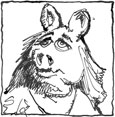
As Miss Piggie would say, “Moi?”

They would criticize moi . . . with my right behavior, exemplary action and pure motive most of the time? Certainly anybody that would possibly find fault with anything I have ever done or said just hasn’t understood me.

Where’s their sense of grace, their sensitivity, their larger perspective, their sense of humor?

They should know I’m like Garrison Keillor’s Norwegian Bachelor Farmers, “pure mostly.”

Or, like Gilbert and Sulivan’s Captain of the Pinafore, who bad language or abuse he does never use!

“Well . . . hardly ever.”

So, of course, I’m appalled when I overhear someone saying even the slightest slight against my mostly pure, mostly good show of actions and words. They should at least assume that I meant well, and even did well, from my perspective which, of course, is the one that is right and true.

Isn’t this so with you too?

People!!!!

Ah, but who can control what others will say? We might as well assume that each of us is part of their conversation, at least at moments, and the grade we’re given isn’t always “A-plus-plus,” even if that’s what we deserve.

We know we haven’t always judged others so high.

So it’s best not to sneak peaks at the report cards or eavesdrop on private conversations.

Best to give some space. Maybe we’ll receive some in return.


__________________

*Ecclesiastes 7:21,22

Next: The Value of Wisdom’s Rebuke. Coming Thursday.

12 Comments

Depending on Folly

July 13th, 2012

Here’s another from our Ecclesiastical Sage: I saw that wisdom is better than folly, just as light is better than darkness.*

Well, Duhhh….

Did it take the wisest man in the world to come up with that?
Light’s better than dark. Pretty black and white.
It hardly needs saying.

Then again, there’s quite a bit of evidence that we don’t all see it that way. In fact, it seems a lot of our society–and economy–is dependent on folly. Maybe we need folly in order to keep certain occupations and even whole systems in place.

I’ve been in areas of the world where night watchmen are kept busy patrolling all neighborhoods. They say a third of the population is hired by a third of the population to protect itself from a third of the population.

I suppose it steadies the economy, providing occupation for all.

Without a little folly, what, for example, would newspapers have to talk about?
And what would the courts do?
Or the police?
Or personal body guards?
Or the military?
Or the whole penal system?
Or lawmakers?
Parole officers?
Drug dealers?
Late night revelers?
All manner of counselors?
Psychiatrists?
Ambulance drivers?
Pawn brokers?
Lawyers?
Pimps?
Pornographers?
Prostitutes?
Arbitrators?
Bailiffs?
Bouncers?
Bill collectors?
Strippers?
Gaming dealers?
Palm readers?

Unfortunately, the list could go on and on.

And let’s not forget about half the writers and artists.

(Of whom I am one.)


__________________
*Ecclesiastes 2:13

Next: A Critique of Moi? Coming Monday.

7 Comments

Listen

July 9th, 2012

Guard your steps when you go to the house of God. Go near and listen rather than to offer the sacrifice of fools, who do not know that they do wrong.*

The last couple of posts have addressed the subject of words, first their power, then the wisdom of their brevity. This one goes farther, that there’s a time for none at all, when listening is the order of the day.

It’s no coincidence that God gave each of us one mouth and two ears. Maybe we’re to listen twice as much as we talk.

Fact: The mind is only open when the mouth is shut.

Another fact: Though we can close our mouth, we can’t in the same way close our ears. We’re meant to listen.

And we’ll look smarter doing it. As someone has said, “It’s better to be quiet and be thought a fool than to open your mouth and remove all doubt.”

The context from Ecclesiastes speaks specifically of our actions in the presence of God, and as I asked before, where isn’t that?

It warns of offering “the sacrifice of fools.”

What is the sacrifice of fools?

Except maybe excuses, defenses, justifications and blame?

Any of that, when standing in front of the One who sees straight through me, isn’t foolishness; it’s idiocy. Exactly Who do I think I’m fooling?

If I am going to make a sacrifice, it seems best to start with my ego. It’ll hurt just a little, will likely help a lot, and God knows there’ll be plenty left.

Best to just be quiet and listen to whatever He might have to say.

Remaining quiet . . . it’s a small sacrifice.

And a wise one.


_____________________

*Ecclesiastes 5:1

Next: Depending on Folly. Coming Thursday.

7 Comments

Let Your Words be Few

July 1st, 2012

Detail from “Eloquent Commentary” by artist/wife Anne Moore, whose words are generally few, but sometimes used to good avail in her eloquent creations. Click for larger view, and others on her site.

Last time the subject was the power of words. Perhaps it’s because of their power we’re cautioned about their plethora. Here’s the word on it:

Do not be quick with your mouth, do not be hasty in your heart to utter anything before God. God is in heaven and you are on earth, so let your words be few.*

Let your words be few.
Not none.
We are meant to speak.

But know this: Whatever you think you’re saying, you’re saying as much about yourself.

Wittingly or not, it’s always a self-portrait we’re painting. And the fewer the strokes, the better the painting.

Speaking on the transparency of every person, Jesus said, “It’s from the outflow of the heart that the mouth speaks.”**

Better to work on the heart than the vocabulary. What’s inside will always come out.

Another thing: Under-promise, over-deliver. You’ll never disappoint.

Thomas Carlyle said, “If you do not wish a man to do a thing, you had better get him to talk about it; for the more men talk, the more likely they are to do nothing else.”

Talk’s cheap. “When words are scarce, they’re seldom spent in vain.” Shakespeare.

Let your words be few.
Measure them.
Particularly in the presence of God.
And where isn’t that?


____________________________

*  Ecclesiastes 5:2
**Luke 6:45 (my paraphrase)

Note: For the next while, these blogs will be posted twice weekly (instead of every four days), Mondays and Thursdays. As always, feel free to share with a friend; and feel free to comment.
Next: An e-gallery, with recent art pursuits and announcing an upcoming plein air painting workshop.


14 Comments

Words: Goads and Nails

June 26th, 2012

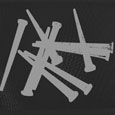
The words of the wise are like goads, their collected sayings like firmly embedded nails—given by one shepherd.*

Now there’s a mix of metaphor. And simile. The similes I understand: Wise words are like goads, driving us on; they’re like nails, pounded in and fastened. But by a shepherd?

Apparently this is one multi-talented sheepherder, and multi-tooled.

And the sheep? I guess that’s dull witted us.

But my thoughts today are about the words themselves. Whether we’re a shepherd or a sheep, words are extensions of our ourselves, and the most powerful tools we have. With them we both create and destroy.

Seems they’re the most powerful things God has, too. He just said, “Let there be . . .” and all came into being.

In a similar way, we do the same. At the beginning of anything, we voice our ideas. It may be only to ourselves, but after that a new thing is born.

They also destroy. “Off with her head!” said the Queen of Hearts, too glibly and too often. We, I’m afraid, are guilty of same. It’s by our words we maim and murder.

Words are strong, even when soft. We use them casually, absently, too often foolishly. The wise use them with care, and often not at all.

Words are goads and nails, and a whole lot more.

Goads of the guide, leading from behind
Nails of the parent, driving lessons home
Fertile field of the poet
Molding clay of the teacher
Scepter of the leader
Door stop of the authority
Balm of the comforter
Wedge of the persuader
Bond of a marriage
Glue of a promise
Law of a contract
Flowers of a lover
Healer of the hurt
Clarifier of the confused
Enlightener of the simple
Forgiver of the offended
Connector of friends
Workbench of the thinker
Bomb of the destroyer
By them we command demons
By them we appeal to God

The list could go on. Feel free to add. Use your own words.

They are yours to use.


__________________________

*Ecclesiastes 12:11

Next: Let Your Words be Few. Coming Saturday.

5 Comments