Their Story, part 4: Traveling Blood

September 4th, 2014

First: thanks so much for all the lovely remarks on my “Forever 71″ (the last Blank Slate blog). Second: some weren’t able to open the last Blank Canvas blog, “Painting in Stages.” All such are viewable here on the website located under the bars at the top. Third: We’re traveling.

It’s been awhile since I’ve posted accounts of my family lore, but if you’ll remember, there are deep roots in Wyoming. Now we (Anne and I) are headed there. After a full day in the van yesterday we had dinner across from the Great Salt Lake in Utah, and ended up last night in a quaint find, Lava Hot Springs, Idaho (pop. 400). We’re on our way to Yellowstone, and after that, Jackson Hole.

The creaky old inn at Lava Hot Springs might have been new when my parents were first married and making their own early trips. Not that they would have stayed in it, flat broke as they were. But we’re finding it quite charming. The shower is in an old claw-foot tub, located in the communal guest bathroom . . . down the hall.

Folks are friendly. Fellow guests just told us how it snowed last week in Yellowstone. Good thing we’re not camping . . . which is the only way we ever traveled when I was growing up.

Here’s an account of an early trip by my mother just weeks after getting married, with Dad and two of his brothers. They headed out of Wyoming over to the west coast and, without result, back again. It gives a picture of how things were.

Hy had occasional jobs, one lasted one day—some a week, one a month or so at the power house at the Semino Dam, where Comer was working. At the end of that month, the job was over because the power house was finished.

The next week we decided to go to Washington to see if the men could get jobs at Grand Coulee Dam. Comer, Muriel, Hy and I started out in Comer’s car with a minimum of camping gear and a minimum of money. The four of us took turns, two would sleep in the car, and the other two would sleep on the ground, unless we could get a motel for $3.00, the maximum we could pay, and we often got one for that price. Some-times we would sleep in a park, once in a hay stack, once on the ground in Yellowstone Park.

Because the men didn’t belong to a union, they couldn’t get jobs at Grand Coulee. We decided to keep on going to the west coast and visit the World’s Fair in San Francisco. They had pay checks coming from their jobs at Semino Dam, so we sent a telegram to Mother Moore to ask her to mail those pay checks to us.

We chose a small town near San Francisco because we figured it would be easier to find a post office there than in San Francisco and asked her to mail them General Delivery. On our way we saw many things new to us, including the Columbia River Highway, the Redwoods, and the Pacific Ocean.

After two days at the World’s Fair we headed home, stopping to “swim” in the Great Salt Lake on the way. We used a coffee can and every day or so we’d each put an equal amount of money in the can and all expenses were paid out of that. Our two week trip for four people cost us $200!
4 Comments

Forever 71

September 1st, 2014

Hyatt-by-Pil-650

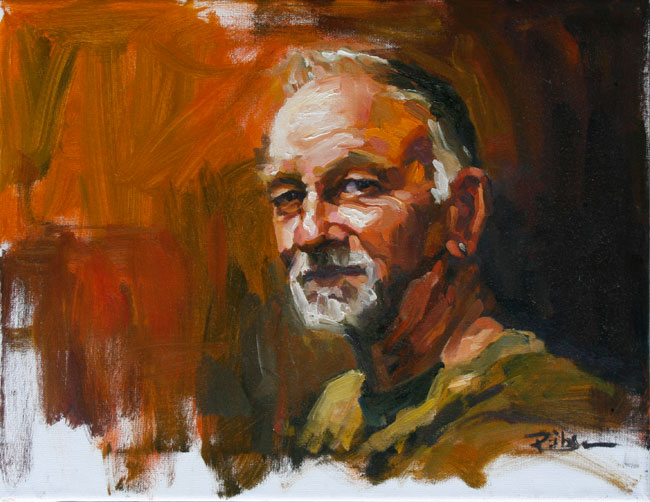
A Portrait of the Artist as a Middle-aged Man, (my title), painted last year by my friend and student, Ho Pil Lee, and given to me as a gift. Thanks, Pil.

This is the day, when she was alive, I would call my mother and congratulate her on the birth of her first son. I was born on Labor Day, the same as everybody else really, and there should be a holiday for every woman who’s gone through it. And that’s besides Mothers Day.

Some years ago I decided not to make a big thing about any more birthdays. You can die from too many of them. Okay, I might celebrate those that end in a zero or a five. Then, if I get to 90, I’ll start celebrating them every six months!

But today’s ends in a “1.” I’m forever 21+50. How does that feel? So far, not that different . . . except unlike when I turned 21, today I’ll stay sober.

A birthday, to me, is something of a personal New Years. It’s a time to look back, and a time to look ahead. Of course, as time goes by there’s more to look back at than forward to. But still, forward is the better view.

When driving, the rear-view mirror is useful, but it’s the windshield that really matters.

I’ve made a new acquaintance lately, an art consultant and dealer. I was complimented when he was taken with mine, “both the quality and quantity.” As we talked he said, “What you need is a 20-year plan.” It’s the kind of idea I rise to, but as I thought about it, that should probably be adjusted to a ten-year plan. Or maybe five.

I get ideas. Often more in number than hours in a day, and grander than there are years to do them.

A couple of years ago I read a book about artists and their productivity in later life. I suppose it should be no surprise that I can’t remember its title or author, or where I put it. But just the concept inspires.

Not like the one I came across looking for the other, James Joyce’s A Portrait of the Artist as a Young Man. Seems there should be a sequel to that one, substituting the word “old.”

James Joyce, of course, is dead. Too many birthdays.

This morning I found a note I’d scribbled to myself at a waking moment in the night:
These things are not forever–
But there are things that are.
Focus on them.

“Forever 71”—not. But “Forever Something.”

Happy Labor Day. (Thank your mother.)

33 Comments

Vernon’s Progress–Still a Long Trek Ahead

August 25th, 2014

Vernon-and-Dad

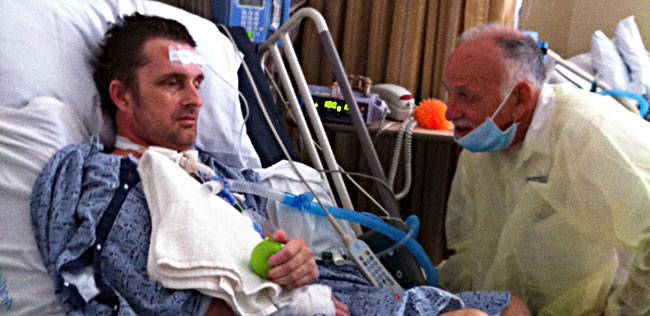
Vernon and Dad, with communication still only one way (that we know of).

Of course the whole crisis with son-in-law Vernon has affect all of us. We’ve been very grateful for the way so many have rallied to Allison and family; and we’re grateful for the way she is holding up. It’s not just because I’m her father that I can say I’m impressed with her strength.

Yesterday Anne and I traveled up to the new care unit–a rehab facility. It’s a good place, but a significantly greater distance than the hospital has been, and it’s going to make changes all around. Vernon’s son Maki (12) is also about to return from his two months in New Zealand. He’ll be starting school and this, along with Justine starting preschool, is also going to mean changes—particularly for Allison and her schedule.

Then there’s work. She’s a superb photographer, easel painter and muralist, and she’s slowly building her business up. But the income is irregular. Basically they’ve lived on Vernon’s typeface design business, and he was just getting into yet another business to augment that when Vespa hit truck and everything came crashing down.

At first and for a long time it was a matter of survival. Then reconstruction. And it’s still dealing with infection. We’ve seen progress, but it’s still very slow. Next is the long road of relearning everything. When we saw Vernon yesterday, he was squeezing a ball and every now and then kicking a leg. But there’s still little or no recognition in the eyes, certainly not talking—what with the tracheotomy. It’s obvious this is going to be a very long haul.

And it’ll be a long time before he starts working again, and billing for his services.

So, there are various levels to this challenge, medical, financial, legal, and of course always emotional. In none of them do we operate alone. In some we depend on professional service, others the aid of friends and family. In it all, God helps us.

For an ongoing update, well written, informative and often endearing, check the sansoxygen blog.


_____________
You don’t believe me on the creative photography? Check her website at allisonmoorephoto.com.

12 Comments

Set your own Due Dates

August 21st, 2014

Watch-Gears-Color
Time goes, you say? Ah no!
Time stays,
we go.

One of the things we need to do to get anything done is to set a mental due date. It sounds obvious, but a lot of good never gets started because the due date isn’t set, or started but never finished.

In fact, it can be easy to be addicted to new starts, but knowing how to plow through, how to finish, that can be the challenge.

Those that do this already probably don’t need the reminder. Maybe a pinch of the opposite. But others may profit from the push.

Also, note that I said hold yourself to it. With others, you may need another discipline: a bit of grace and patience.

In setting your dates, be realistic. Know how long things take. Set the projected completion date, then work backwards with the steps, scheduling increments of progress. These, then, are mini-due dates.

Though it makes a slightly different point, I’ve always liked a quote by Henri Matisse: “When I found my true path, I took fright, realizing that I could not turn back. So I charged ahead into my work with my head down, following the principle that all my life I had understood by the words, ‘Hurry up?”*

There was a man who was called. In the end he produced thousands of works. I don’t doubt that he was working with self-imposed due dates in is mind all the time.

It matters what we do, and if we don’t schedule it, little happens. “Time,” I once read, “is the chrysalis of eternity.”

In eternity there are no due dates.

But today is another matter.

______
*Matisse, A Retrospective, Jack Flam, Wing Books, New York

5 Comments

Your Calling

August 18th, 2014

Two blogs ago I brought up the powerful and releasing concept of “our contribution.” A few responded; I’m always grateful. Today, it’s another topic, related but different, and all the more life-changing.

Our contribution, as I explained, comes from a bit of self-analysis, an identification of our own particular uniqueness, then a determination to put that into practice for the wider good.

Calling has the same effect, but originates from a higher place.

Recently the small group of friends with whom we regularly meet, addressed this notion personally. Am I called? To what? How do I know? What am I doing about it?

These are the questions, the answers to which can bring profound focus to the life, and ultimately affect the lives of others.

A synonym for calling is vocation. That comes from having heard something vocalized, likely at a very deep level, which then becomes our life work. It’s something so strong, we really have no choice.

In making our contribution we take the initiative. Our calling, on the other hand, did not originate with us. It’s something we really can’t get out of. At least not without a strong denial and resistance.

Calling can manifest in either of two ways . . . using known gifts for a new and deeper purpose, or realizing new gifts. The Apostle Paul was of the first category, Peter of the second. Paul was a man of imposing intellect and unrelenting zeal. The calling he experienced mid-career ended up using those same powers but for a different cause. It changed the world. The Apostle Peter, on the other hand, when he was called, left his primary occupation altogether. (That changed the world too.)

When we personalized these thoughts in our little group, identified our own sense of calling, we found it of great benefit for each of us.

So I recommend it to you. Are you called?

Identifying it has great motivating power.

And could change the world. At least yours.


15 Comments

Write your own Job Description

August 13th, 2014

Shaking-hands

Last time the topic was “your contribution,” that which only you can offer and if you don’t, it won’t happen. I trust you saw it. I’ve been experiencing some Internet glitches. If not, it’s there in the list of recent posts at the right.

This time the topic is what that contribution might look like as you work to carry it out.

In the nine-to-five working world, the concept of a job description is pretty normal. Maybe it’s written, maybe not; either way there’s an expectation between manager and worker of what needs to be done, to what ends, and more-or-less how.

Here we’re talking about drawing one up for yourself. Though only you will see it, putting it in writing makes it more real, and thus more useful.

First, how many hours per day are you willing to commit to your occupation? We’re talking here about a self-occupation, something of your own unique contribution. It’ll be outside of whatever else you’ve got going or whatever others are expecting of you. So you need to be realistic, not expecting too much.

But if you don’t commit to “something,” years can go by with “nothing.”

Then, which hours, morning or afternoon, or other? If not every day, which days? If it all isn’t pretty specific, it’ll get away from you. You lose your momentum . . . the good idea starts to slip away and ends up in the dusty file cabinets of so many others that have gone before.

Then, describe the activities. And the results aimed for. And benchmarks of progress.

There can be many other aspects of a job description but these are probably enough. It need not be cumbersome, certainly not onerous. You’re doing it for yourself. You’re setting up an expectation for yourself and then are committing to doing it. Simple.

It’s all part of taking yourself seriously, and your contribution.

So get that job description going. Have your boss check it over. (That’s you, too.) Make sure it’s realistic . . . not too much, not too little. Have your two selves agree to it. And then start showing up for work.

You’ll be surprised how, in time, things are happening that weren’t before, with results that will please you, and everybody else.


____________
PS For those interested in Vernon’s ongoing progress, here’s yesterday’s update by daughter Allison. You’ll enjoy the photos included as well, taken by another family member, Nicole. It’s here: sansoxygen.com/miss/

4 Comments

Your Contribution

August 7th, 2014

Hand-Nigeria-115
Casting about for something to illustrate this, like “a helping hand,” all I could find was a drawing I did in Nigeria in ’03 . . . a place where I hope I made a contribution.

Taking a break from the recent theme of my parents’ history, today’s thoughts have to do with you.

Specifically, your contribution. The fact that you have one, and that contributing it matters.

What is it that you do, that only you can do?

Think about it.

We live not just for ourselves. Even if our work is done in a solitary way, in the end it’s for a wider world.

What is it you would do even if no one paid you for it . . . if no one asked you do to it?

In many ways it’s why we were born. Seeing our unique set of gifts as contribution gives us reason for being.

Another thing: I learned a long time ago that the one who sees a need most clearly is almost always the one to address it. Not the nebulous “they.” They will never see it. They will never do it. Not right.

Further: Making our unique contribution brings the best out in us. We abandon ourselves to whatever it is and have done with debilitating self-consciousness.

We contribute to a higher cause . . . even if for only one person. Even if for only a child.

So, here’s my challenge for you. Identify your life contribution. If that’s too big, make it just for today.

State who you’re doing it for.

Then get on with it.

The world will be better. And so will you.

6 Comments

Mom’s Story: Bibs, Teeth, Coats

August 1st, 2014

Details continue of Mom’s reminiscences. She’d always said her parents were poor, but since I didn’t grow up this way, I never realized how poor. (And neither did she at the time . . . would even say later that it stood her in good stead.)

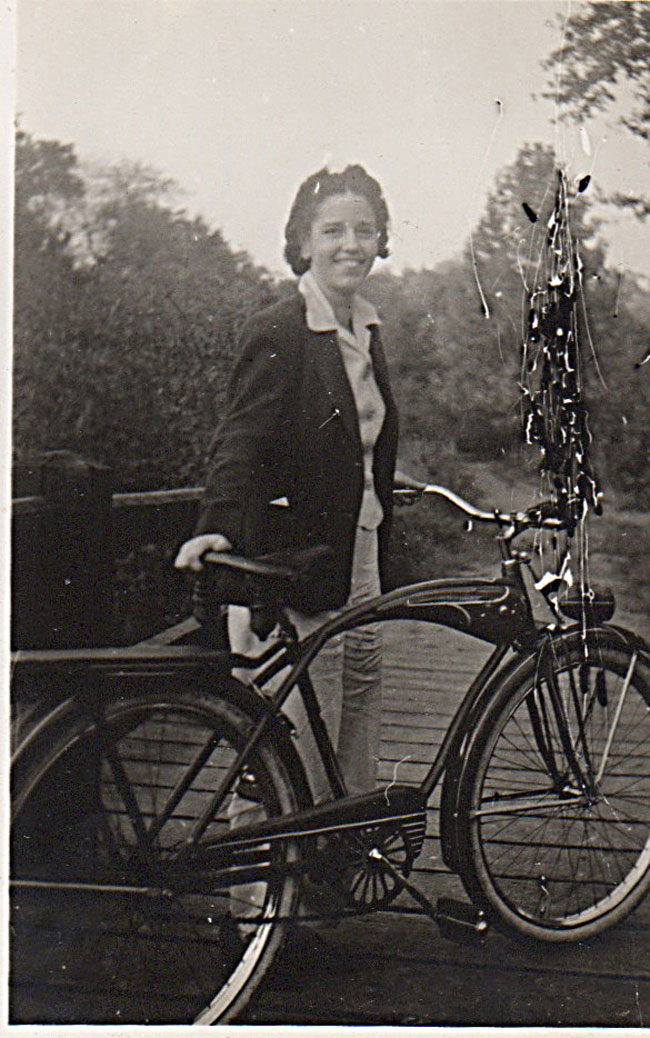
Betty-Moore-and-bike-650

The photo is from a slightly later date, and more prosperous time, by then married, and with a bike! (BTW, that bike stayed in the family until Dad was in his 90’s.)

We never heard of napkins, either cloth or paper.

When one of us kids would get a messy face or hands while eating, my mother would get up from the table to get a dishtowel, which she would wet a corner of and use to wipe face and hands. And sometimes Dad would use a dishtowel (“tea towel”) as a bib.

But of course that would make more washing for my mother.

At the end of a washday her knuckles would be bleeding from all the scrubbing of clothes on the board. I was as glad as she was when she finally got a washing machine. It isn’t any wonder that women of that generation became old and worn-out, often toothless, from too hard work and much child-bearing, before they were 40.

Both my parents got false teeth before that age. People then just went to the dentist to have a tooth pulled!

I never went to the dentist until I was 18. And that was because I moved to the big city of Denver for the summer and had a job as a live in housemaid. I got room and board and three dollars a week. The woman I worked for helped me find a dentist and I took the bus downtown to see him. He found nine cavities!

I don’t know what his regular price was but when he learned how much I made he charged me only one dollar per filling.

The rest of the money I made that summer I used to put a winter coat on layaway. I think it cost $15. When I decided to go back home to live and graduate, I didn’t have enough time to work to pay off the coat. Instead I had to buy a bus ticket from Denver to Yuma, where my parents had moved.

I think I expected they would pay off the coat for me but they didn’t have the money. A new friend of my mother’s did it for me just in time for cold weather.

I doubt if anyone will believe these stories but they are all true.

3 Comments

Vernon, by Allison

July 29th, 2014

Scuba-Diver-115
A little painting by Allison illustrating yesterday’s update. The oxygen tank is no coincidence.

People often ask how Vernon is doing. You’ll remember he had an encounter with a truck on his motor scooter over two months ago. I tell them he’s still in the coma, though making progress . . . if very slowly. I also recommend them to the blog created especially for him with daily updates, mostly by Allison, Vernon’s wife and main caretaker (at the hospital every day).

And I’ll recommend it to you.

In it you’ll not only learn of Vernon’s progress, you’ll come to know Allison, a creative writer, a buoyant spirit, a Christian, an overcomer, an involved mother, an inspired photographer and an artist. Do I sound proud? Of course I am, and all the more for how she is handling this very challenging period of life . . . one which none of us would choose.

And by the blog you’ll also observe a community at work around her, and Vernon . . . the kind of which is essential for such a time as this . . . and not to be taken for granted.

I could say more, but I’d rather you go over to the “Sans Oxygen” site (named after one of Vernon’s typefaces): http://sansoxygen.com/.

8 Comments

Mom’s Story: Dish Washing

July 24th, 2014

I just poured and drank a glass of orange juice. On finishing I thought to rinse it out, dry it, and put it away. But, too much work. I put it in the dishwasher. Then I came across the following except, again from one of my mother’s letters:

One time when I was allowed to go to someone’s house after school I came home and my mother asked me what I had done. I told her I had helped my friend with her mother’s unwashed dishes. 

That was the thing mothers did in those days, leave the dishes for daughters to do after school. It was probably so the mother could do other things, like sewing clothes for her kids or cooking, or canning fruit, or any one of a myriad other things that consumed the mother’s time.  Of course girls always hated to have to do dishes, being the most menial of all menial tasks, so it made it easier if a friend could help. 

My mother half laughed and half scolded me for being willing to do someones dishes but complained about doing my own.

In those days it was a lot more work to do dishes. We would use two dishpans. When we got the second pan full of washed dishes we would SCALD them by pouring a teakettle of boiling water over them. Then that pan got full of water. We never heard of a dish rack – don’t think they existed. With no rack, the dishtowels (we called tea towels) would get sopping wet from drying dishes so it took several towels before we were finished.   

In those days a popular wedding shower gift was a set of seven dishtowels.

Question: I wonder if the Wedding Registry at Nordstroms gets many calls for sets of dishtowels. (Rather, “tea towels.”)

4 Comments